Every founder says their startup is “the next big thing.” Investors vote with cheques instead, and those cheques say something very different from the pitch decks.
The big picture
Indian startup funding is recovering, but slowly. Funding fell 8% year-on-year to about $11 billion in 2025, after $10 billion in 2023’s funding winter. Money is also moving toward harder, more technical bets, even though the headline numbers look flat.
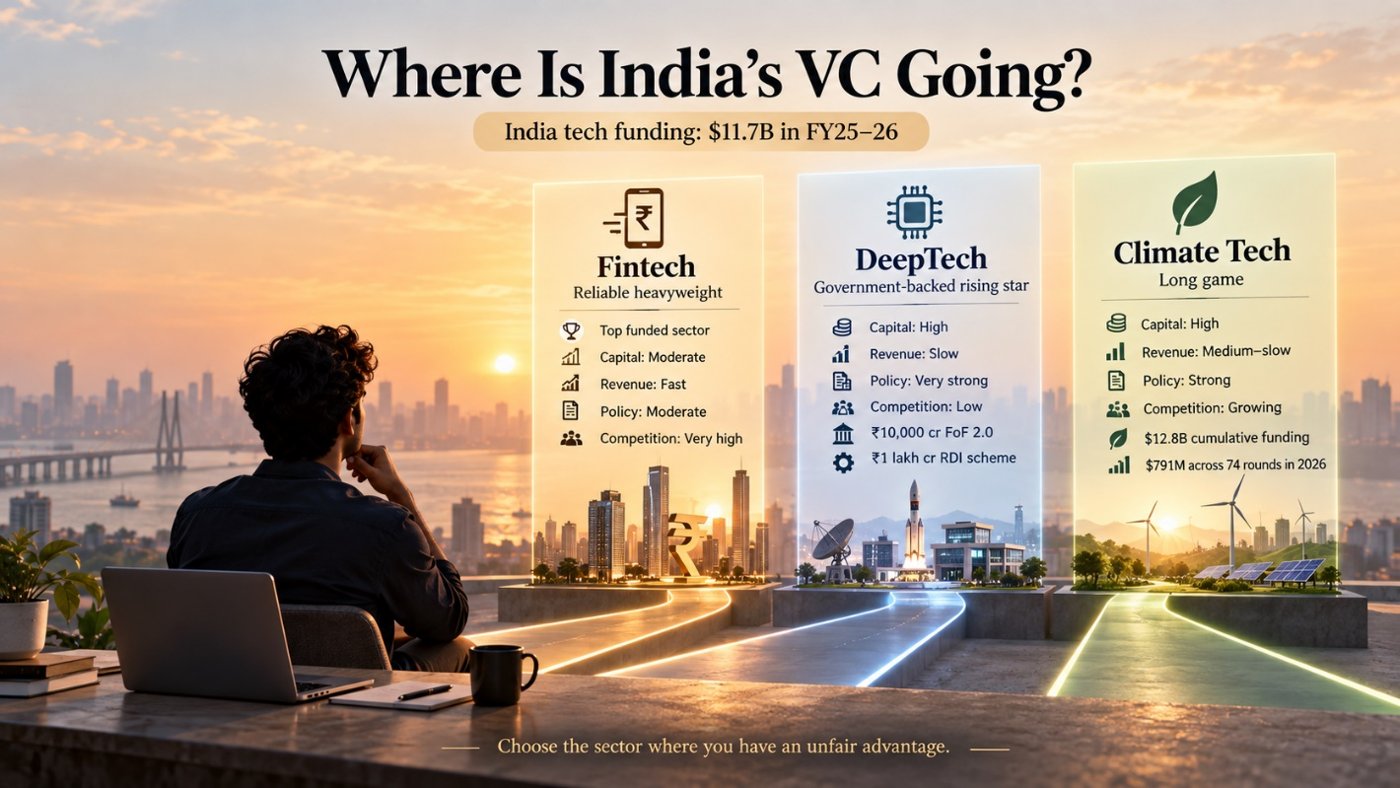
Fintech: the reliable heavyweight
Fintech remains the sector with the most money in it. Fintech, enterprise tech and ecommerce still dominated sector-wise funding in 2025, and fintech’s total was almost unchanged from 2024. Think payments, lending infrastructure and wealth platforms. Investors like it because UPI-scale distribution already exists and revenue models are proven. The catch is that it is crowded, so a new fintech needs a sharp niche or a real regulatory or data advantage.
DeepTech: the government-backed rising star
DeepTech covers semiconductors, robotics, space, defence and advanced hardware. It is capital-heavy and slow, which is why policy support matters. Union minister Piyush Goyal announced that a substantial part of the ₹10,000 crore Startup Fund of Funds would go exclusively to deeptech, alongside a ₹1 lakh crore Anusandhan Fund for long-term R&D. Firms like 888VC, Riceberg Ventures and Chiratae Ventures launched new deeptech-focused funds. Deeptech took in only $460 million across 73 deals in 2024, so it is small today, but investor interest is growing faster than the deal values show.
Climate Tech: the long game
Tracxn’s India Climate Tech 2026 report puts cumulative funding at about $12.8 billion across 1,583 companies, with $791 million across 74 rounds so far in 2026. A strong driver is energy security: nearly 85% of India’s crude oil is imported, so renewables, EVs, batteries and critical minerals matter beyond climate goals. The weak spot is later-stage money. Roughly two-thirds of India’s 800 climate tech startups have raised seed funding, but fewer than 3% have reached Series B or beyond.
So which one wins?
| Fintech | DeepTech | ClimateTech | |
|---|---|---|---|
| Capital needed | Moderate | High | High |
| Time to revenue | Fast | Slow | Medium–slow |
| Policy tailwind | Moderate | Very strong | Strong |
| Competition | Very high | Low | Growing |