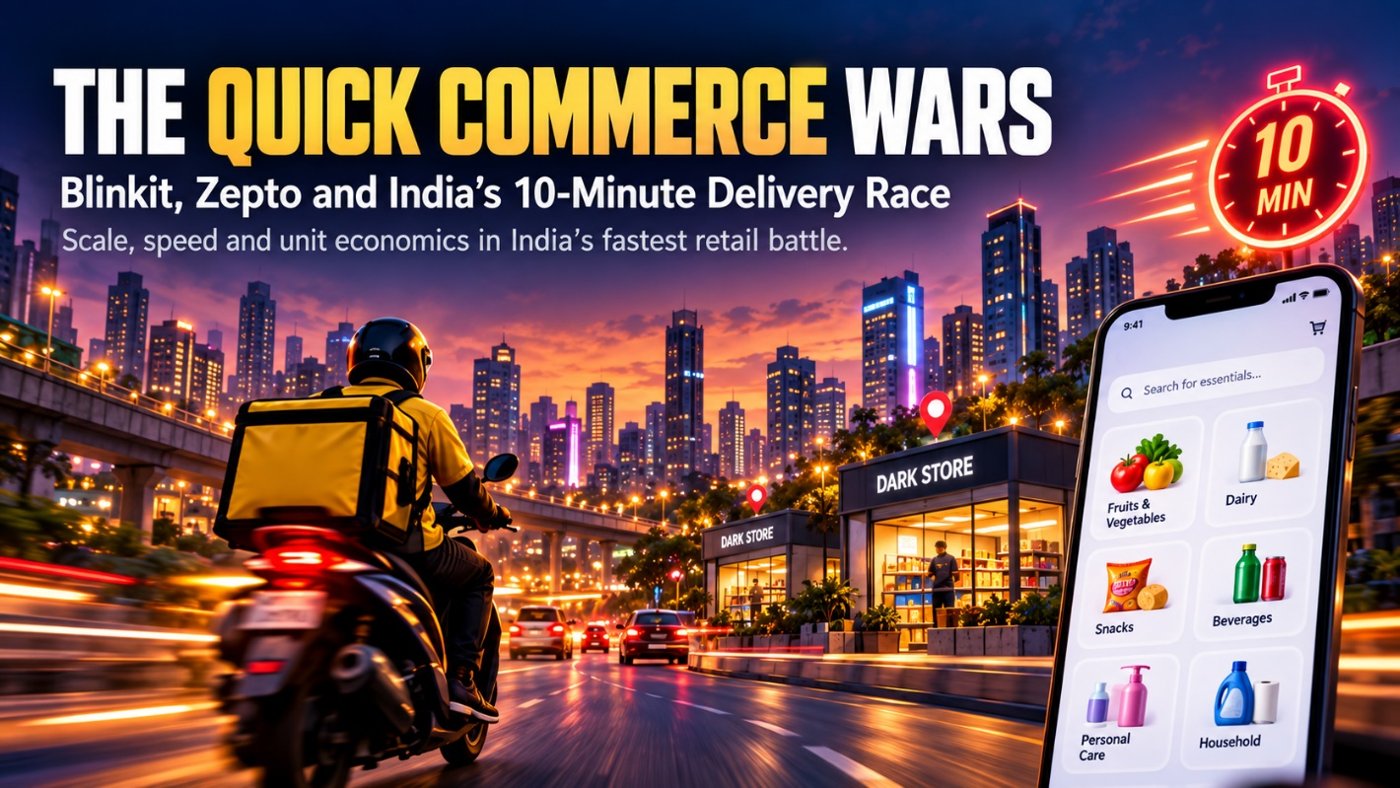
Ten minutes. That’s all it takes for a packet of milk, a phone charger, or a midnight ice cream to reach your door. Behind that speed is one of the most expensive, high-stakes battles in Indian business.
How big is this?
Equirus estimates quick commerce at around ₹1.08 lakh crore, growing about 40% year-on-year, roughly twice the pace of overall digital commerce. The three largest platforms’ combined dark store network grew nearly 48% to 5,026 stores in May 2026.
The players
Blinkit (owned by Eternal, formerly Zomato) started life as Grofers and reinvented itself. It processed 916.6 million orders in FY26, with revenue of ₹37,779 crore and an adjusted EBITDA loss of just ₹277 crore. That near-breakeven position makes it the profitability benchmark.
Zepto was founded in 2021 and is now preparing a stock market debut. It handled 640.2 million orders in FY26, with revenue of ₹22,624 crore but an adjusted EBITDA loss of ₹5,042 crore. It is growing fast, but at a heavy cost.
Swiggy Instamart has been losing ground. Its share of orders among the top three fell from 34.3% in FY24 to 20.9% in FY26, even though its absolute orders more than doubled to 412.2 million.
New challengers keep entering, including BigBasket’s BB Now, Flipkart Minutes and Amazon Now.
Why is it so hard to win?
Quick commerce is, at heart, a logistics business dressed up in a retail interface. The economics depend on a few things:
- Dark stores. Small warehouses placed close to customers. Rent, staff and inventory are costly.
- Order value. Delivery costs the same whether the basket is ₹200 or ₹700, so bigger baskets mean better margins.
- Density. A dark store needs enough orders nearby to stay busy.
- Advertising. Brands pay to be visible in the app, which is a major profit lever.
- Discounts. Used to win customers, but expensive to keep up.
Is the model sustainable?
Industry watchers noted that the sector is moving from aggressive expansion toward profitability and sustainability. Blinkit’s near-profit result suggests the model can work at scale, but Zepto’s losses show how much cash the race can consume.
Lessons for aspiring entrepreneurs
- Operations are a moat. The winner is often the one with the best execution, not the best app.
- Unit economics matter. Growth without margins eventually runs out of cash.
- Large markets still have gaps. Quick commerce is now moving into electronics, beauty, pharmacy, and smaller towns.
- There’s a supply-side opportunity. Brands, packaging, cold-chain logistics and dark-store software are all startup territory.